The life of the mind in America by Perry Miller
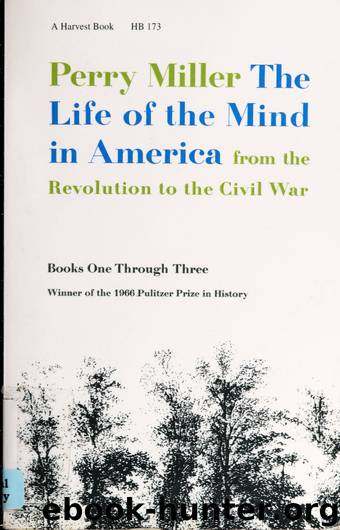
Author:Perry Miller
Language: eng
Format: epub
ISBN: 115651990X
Publisher: Harcourt Brace Jovanovich
Published: 1965-03-15T05:00:00+00:00
3 .
EQUITY
In 1760 Lord Karnes presented to Benjamin Franklin his The Principles of Equity. Franklin answered that he would send copies to the Americas, not only to those which had courts of chancery but to those which, “having no such courts, are obliged to mix equity with the Common Law/’ The book would be of service in either sort, since few of the colonial judges “have been bred to the law/'
In the colonies, such controversies as in mid-eighteenth-century England were finding their way to Chancery usually had to be adjudicated, if at all, by the legislatures. Their jurisprudence. Story would charitably relate, was “lax." Hence the new nation had no viable precedents. It got little help from its favorite textbook: Blackstone said so little about equity as to make it sound unattractive. The liberty of considering cases in an equitable light, he said, should not be indulged very far, “lest therefore we destroy all law.” Though Common Law without equity might appear hard and disagreeable, the public good would less be served by equity without law. Pure equity, Blackstone warned, “would make every judge a legislator, and introduce the most infinite confusion.’’
Wherefore, when the American profession, acting upon Franklin’s insight, advocated a system of equity, it found itself with still another, and this time extremely bitter, fight on its hands. Hostility was particularly virulent in Massachusetts. There, Erastus Worthington commented in 1810 how only a few years before the people had imagined the Common Law to be a terror, but now, twenty years after that debate, their veneration for it had become so fanatical that they rejected proposals for equity by shouting, “Touch not with unhallowed hand a single particle of this mighty fabric.’’ In 1829, said The American Jurist, equity was still being presented to the populace “as a shapeless monster that would destroy the law; and the court of chancery has been described as a sort of bottomless pit where thousands of suitors are engulfed in ruin.’’ Another legal journal placed the blame, as did all apologists, upon politicians who, in order to promote selfish interests, made equity diabolical. A pamphlet which circulated through Albany during the Constitutional Convention of 1821, signed by “Hamilton,’’ attacked everything for which the lawyers believed
Alexander Hamilton had stood, especially accusing the property interests of trying to thwart republican institutions through the tyrannical establishment of Chancery.
Nor should we assume that opposition to equity arose only out of the ignorant backwoods. In 1826 Anthony Laussat published in Philadelphia An Essay on Equity in Pennsylvania which almost persuaded John Marshall that the two kinds of courts should not be separated— but not quite. Laussat drove home his point by repeating the pleas of the lawyers that the “malleability” of the Common Law is such that —if the judiciary shows a proper disposition—all the ends of equity can be accomplished under ordinary forms. Instead of fabricating a distinct code, he said, we should remodel the Common Law to meet our emergencies—as we in America are free to do.
Download
This site does not store any files on its server. We only index and link to content provided by other sites. Please contact the content providers to delete copyright contents if any and email us, we'll remove relevant links or contents immediately.
Crystal Cove by Lisa Kleypas(39187)
Spell It Out by David Crystal(36149)
For the Love of Europe by Rick Steves(14563)
Underground: A Human History of the Worlds Beneath Our Feet by Will Hunt(12144)
Tools of Titans by Timothy Ferriss(8490)
Giovanni's Room by James Baldwin(7432)
The Rosie Project by Graeme Simsion(6520)
Beach Read by Emily Henry(5517)
A Year in the Merde by Stephen Clarke(5470)
Perfect Rhythm by Jae(5460)
Spare by Prince Harry The Duke of Sussex(5253)
The Body: A Guide for Occupants by Bill Bryson(5175)
Endurance: Shackleton's Incredible Voyage by Alfred Lansing(4844)
China Rich Girlfriend by Kwan Kevin(4609)
The Silk Roads by Peter Frankopan(4586)
Machine Learning at Scale with H2O by Gregory Keys | David Whiting(4361)
A Game of Thrones 1 by George R R Martin(4217)
The Motorcycle Diaries by Ernesto Che Guevara(4151)
Alive: The Story of the Andes Survivors by Piers Paul Read(4076)
